Bandek Made from Barley and Durum Wheat: What the Study Shows
A new study examines the Moroccan roasted flour Bandek made from four cereal genotypes. Processing and genotype alter starch, beta-glucan, colour and aroma, within clear limits of interpretation.
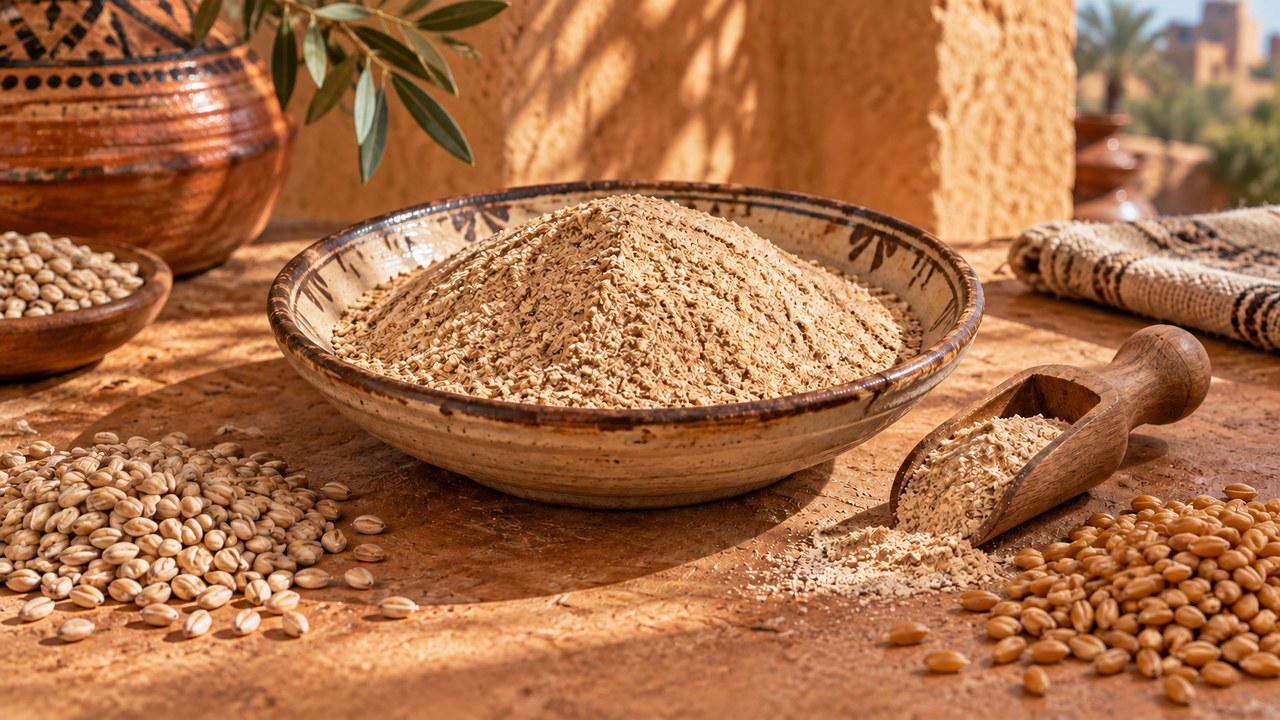
In short: A study published in Foods on 14 September 2026 examines how traditional Moroccan Bandek processing changes four barley and durum-wheat materials. The beta-glucan-rich Chifaa barley retained 6.03 percent beta-glucan and had the lowest laboratory-estimated glycaemic index, at 53.78. The high-amylose durum line Svevo HA had the highest resistant-starch content, at 6.82 percent. These are analytical results from four selected materials, not evidence of a health effect in people.
Bandek is a traditional roasted cereal flour from southern Morocco. Its production combines several steps: cleaning, soaking, steaming, sun-drying, roasting, cooling and milling. This creates a storable ingredient with pronounced roasted notes. The study is interesting because it considers nutrient composition, starch digestibility, colour and volatile aroma compounds together.
Four cereal materials rather than one blanket comparison
The researchers examined the conventional durum wheat Svevo, a high-amylose variant called Svevo HA, the soft-kernel durum Faridur and the hull-less, beta-glucan-rich barley Chifaa. A women’s cooperative in Tata in the Souss region processed about one kilogram of each material using the traditional method.
The grain was soaked for 8 to 12 hours, steamed for 45 to 60 minutes, sun-dried at a reported 28 to 36 degrees Celsius until its moisture content reached 10 to 12 percent, and then roasted for 35 to 50 minutes. It was milled after cooling. Analytical measurements were generally performed in triplicate, while volatile aroma compounds were measured in duplicate.
This care improves comparability within the experiment, but it does not replace a broad market sample. There was only one processed batch of each cereal type. The differences therefore cannot automatically be applied to every cultivar, every cooperative or every Bandek product.
What the study found for starch and beta-glucan
The cereals did not respond identically to the same traditional process. At 6.03 percent, Chifaa remained the sample richest in beta-glucan and showed the lowest estimated glycaemic index. Svevo HA achieved the highest proportion of resistant starch. The work therefore supports an important basic idea: the starting cultivar helps determine which nutritionally interesting components remain after soaking, steaming, drying and roasting.
The reported pGI is a laboratory estimate based on measured in vitro starch digestion. It is not the same as measuring blood glucose in people. A real meal also contains fat, protein, liquid and other ingredients; portion size, individual metabolism and preparation further affect the response. The value of 53.78 therefore supports neither a treatment recommendation nor a guaranteed blood-glucose response.
More measured minerals do not automatically mean better intake
Some mineral concentrations were higher after processing. The authors do not interpret this as newly created minerals, but partly as a concentration effect caused by losses of other components and moisture. At the same time, protein content fell by about 20 percent in all four materials.
A nutritional assessment would also need to determine how readily the digestive tract can absorb the minerals and what a typical portion contains. Changes in phytate and other binding compounds may matter as well. The analysis therefore does not show that Bandek improves mineral intake or is generally superior in nutritional terms.
Roasting changes colour and aroma profile
All the Bandek samples became darker. At the same time, the profile of volatile compounds that can contribute roasted, nutty, malty or caramel-like impressions changed. Heat drives Maillard reactions, among other processes, in which amino compounds react with sugars. Which aromas dominate in a finished dish also depends on milling, storage, added water and other ingredients.
Instrumental measurement of volatile compounds is not a substitute for tasting. The study reports chemical profiles, not the preferences of a large consumer group. Whether one version is perceived as especially pleasant, bitter, intense or balanced would need to be examined in sensory tests using standardised recipes.
Why the traditional process is not a simple kitchen experiment
Soaking and steaming introduce a great deal of moisture into the grain. It must then be dried under controlled conditions to a safe moisture level before storage and milling. Microorganisms or mould can grow if conditions are unsuitable. The sun-drying described in the project took place in a specific artisanal process with defined target values; it is not general guidance for drying wet grain outdoors.
Roasting also requires temperature control. Too little heat will not create the desired aromas, while excessive or uneven heat can burn the grain. Anyone wishing to explore the flavour is better served by a professionally made product than by improvised prolonged drying. Bandek made from barley or durum wheat also contains gluten and is not suitable for people with coeliac disease.
What can be taken from the study for cooking
Roasted cereal flours can add nutty depth to porridges, drinks, baked goods and savoury dishes. Their water absorption and binding properties differ from those of untreated flour. A one-for-one substitution can therefore alter dough consistency, volume and flavour. Small test quantities and recorded liquid additions are more useful than a blanket substitution rule.
Anyone cooking with barley or durum wheat can find starting points in Kochzauber’s breakfast, Mediterranean cuisine and ingredients sections. Above all, the study invites us to consider cereals not only by species, but also by cultivar and processing method.
What the study shows — and what remains open
- What was shown: Four selected cereal materials responded differently in composition, starch digestion, colour and volatile compounds to a documented Bandek process.
- What was not shown: a specific effect on blood glucose, satiety or human health.
- What is not represented: the full diversity of traditional Bandek production in Morocco or all barley and durum-wheat cultivars.
- What remains open: how the variants perform in sensory testing, during longer storage and in standardised final products.
Conclusion: tradition and cultivar choice work together
The new study presents Bandek as the result of a process chain, not simply as “roasted flour”. Soaking, steaming, drying and roasting change the matrix, while the genotype determines the starch, protein and beta-glucan profile of the starting grain. Chifaa and Svevo HA stood out in the laboratory results, but that does not amount to a health claim.
The study’s greatest value lies in its precise documentation of a traditional process and how it interacts with modern cultivar selection. Robust nutritional claims would require more batches, sensory testing and human studies. In the kitchen, Bandek remains above all a culturally rooted, aromatic cereal ingredient that should be produced professionally.
Sources and status
- Hassouni et al.: Effects of Traditional Moroccan Bandek Processing on Nutritional Composition, In Vitro Starch Digestibility, and Volatile Profiles of Barley and Durum Wheat Genotypes, Foods 15(18), 3250, published on 14 September 2026.
- Hassouni et al.: Preprint with details of the methods and results; the peer-reviewed journal version is authoritative for scientific interpretation.
Author: Kochzauber editorial team. Information and last updated: 15 September 2026. Laboratory values and the estimated glycaemic index are not individual nutrition or health advice. The cover image is an editorial illustration.