Apple juice adulteration: new TD-NMR test finds three patterns
A new magnetic-resonance laboratory method distinguishes model apple juices altered with water, sugar or orange juice. At the shelf, labelling remains the practical guide.
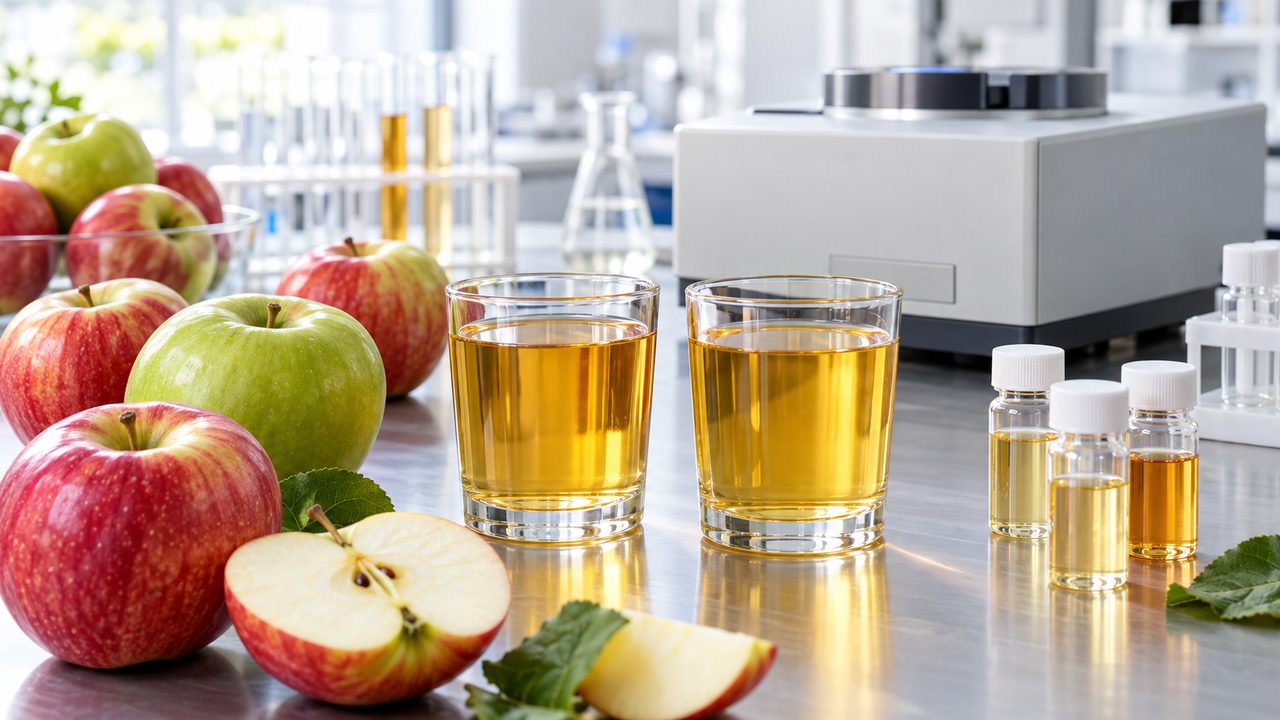
A study published in Food Analytical Methods on 13 October 2026 uses time-domain nuclear magnetic resonance to distinguish deliberately altered apple-juice samples. Water, sugar and orange juice changed the relaxation patterns in different ways. The method may assist authenticity laboratories, but it is not a kitchen test and does not yet prove performance across the full variety of real retail samples.
Why apple juice can be difficult to check
Dilution with water, added sugar or mixing with a cheaper juice can change composition and economic value without making every deviation immediately visible. Genuine apple juice also varies with cultivar, harvest, ripeness and processing. A method must therefore separate natural variation from undeclared alteration.
The new work selected water, sugar and orange juice as three model adulterants. They represent different interventions in the juice matrix. The study did not investigate whether specific products bought in shops had been mislabelled.
How the TD-NMR approach works
TD-NMR measures how hydrogen nuclei return to equilibrium after a magnetic pulse. The study combined relaxation times T1 and T2 with an inverse Laplace transform of the T2 distribution. This makes different water populations and structural components in the juice pattern visible.
The technique is non-destructive and is intended to offer faster routine screening than some elaborate separation methods. It still requires laboratory equipment, standardised samples, calibration and expert interpretation. A home refractometer or taste test cannot replace this multidimensional analysis.
Three additions, three different signals
Water increased both T1 and T2 in the experiments. Orange juice increased T1 but reduced T2. Sugar shortened both relaxation times. Multiple peaks in the ILT analysis also helped separate the tested alteration types.
Those directions are the central new finding: a combination of relaxation features, rather than one total value, forms a fingerprint. Whether it works equally well with other apple cultivars, concentrate, cloud particles, storage stages or several additions together needs separate validation.
What the study does not establish
- No market survey: model samples were tested, not a representative selection from German supermarkets.
- No home test: colour, sweetness or cloudiness cannot reliably reveal an undeclared addition.
- No complete fraud library: water, sugar and orange juice were studied, not every conceivable alteration.
- No blanket clean-label finding: analytically authentic juice may still differ in processing and labelling.
The description “highly accurate” comes from the study’s methodological conclusion. Without freely reported performance figures for every real-world application, it should not be understood as a universal guarantee.
What shoppers can check on the shelf
The regulated sales name is the first clue. Fruit juice consists of fruit; juice from concentrate is restored with water after concentration. Nectar and fruit-juice drinks are different categories with their own rules. “Not from concentrate” describes a production route, not automatically higher sensory quality.
Compare the sales name, ingredients, fruit content and nutrition information instead of relying only on front-of-pack advertising. Correct storage after opening prevents spoilage, not pre-existing mislabelling. Ideas for apples and juice in cooking are available under breakfast and recipes by ingredient.
Conclusion: a tool for inspectors, not a pocket trick
The study of 13 October 2026 shows that T1, T2 and ILT represent three deliberately created changes to apple juice differently. That makes TD-NMR an interesting candidate for rapid authenticity control. Broad use requires robust validation across cultivars, origins, production routes and unknown commercial samples.
Sources
- Food Analytical Methods: original TD-NMR study, published 13 October 2026
- German Federal Centre for Nutrition: apple juice, direct juice, concentrate and nectar
- German Federal Ministry of Food and Agriculture: rules for specific food groups
- EUR-Lex: EU rules on fruit juices and similar products
Author: Kochzauber editorial team. Updated: 15 October 2026. The study tested deliberately prepared model samples, not specific retail brands.