Making underripe coffee cherries more useful: new study tests controlled water immersion
A new Arabica study tests 24 to 192 hours of water immersion with different water-renewal regimes. What the sensory results show – and why this is not a kitchen hack.
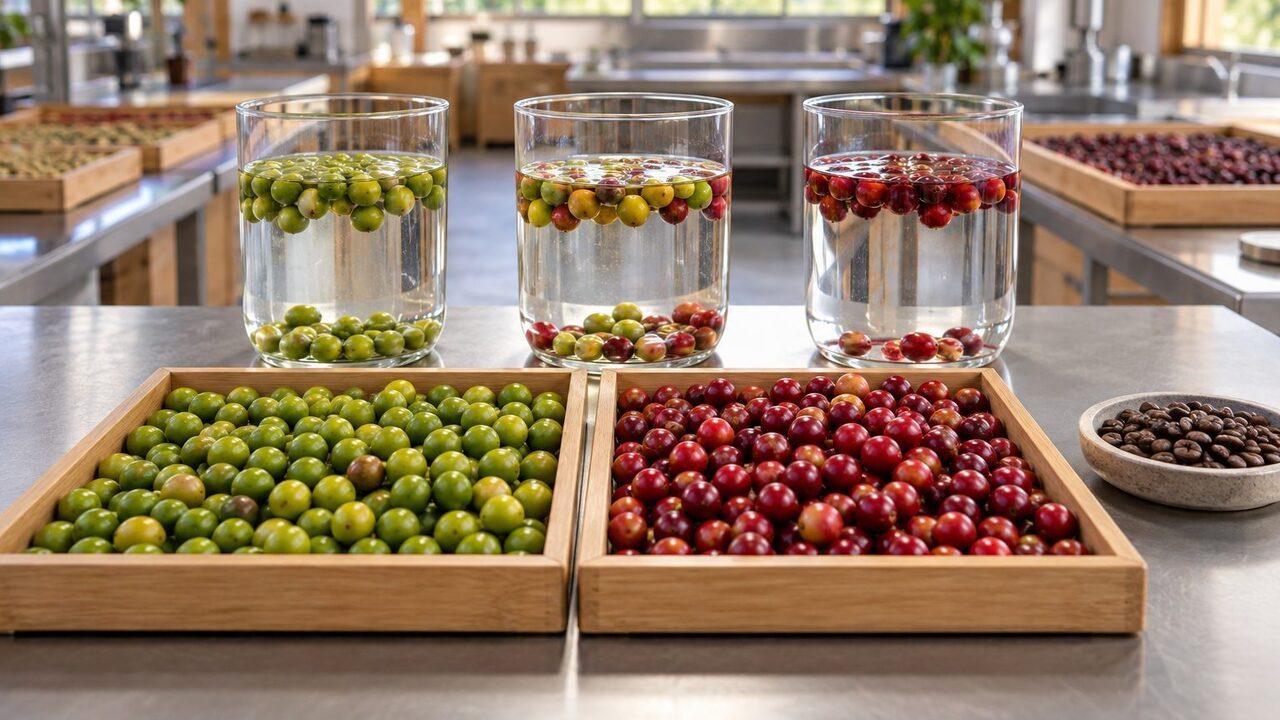
A study published on 1 October 2026 tests whether controlled water immersion can make underripe Arabica coffee cherries more useful. The researchers compared treatments lasting 24 to 192 hours with static water, daily renewal and a combined regime. Processed lots that could be hulled achieved mean sensory results close to the ripe control. This is a professional post-harvest approach, not advice to soak beans at home.
Why underripe fruit is a problem
Coffee cherries do not always ripen at the same time. Green fruit collected with ripe cherries can be harder to hull and can reduce uniformity and cup quality. Earlier FAO guidance identifies a high share of underripe beans as an important quality issue.
The new work does not suggest that immature harvesting is preferable to careful picking. It examines an existing secondary fraction that may otherwise lose value or be discarded, seeking a post-harvest route for better use.
How the experiment was designed
Underripe Coffea arabica fruit underwent static immersion, daily water renewal or a combined regime with daily renewal up to 96 hours followed by static immersion. Total treatment time ranged from 24 to 192 hours.
The researchers then separated fruit that could be mechanically hulled from more resistant unhulled fruit. They measured water conductivity and pH, caffeine, trigonelline, chlorogenic acid, colour and sensory quality.
What happened in the water
Under static conditions, electrical conductivity rose from approximately 2,000 µS cm⁻¹ at 24 hours to more than 7,000 µS cm⁻¹ at 192 hours. Daily renewal kept it substantially lower. The pH in the static system increased from roughly 4.0 to 5.7.
These values indicate that water management and time altered mass transfer. Caffeine, trigonelline and chlorogenic acid varied with treatment, duration and fruit structure. The study does not establish a health improvement or a universal quality gain for coffee.
The sensory results
Hulled underripe coffees scored from 79.00 ± 3.60 to 81.21 ± 0.44, with treatment means of 80.44 to 80.69. The ripe control scored 80.75 ± 0.65. Unhulled lots were lower, ranging from 78.03 ± 0.89 to 79.47 ± 1.08.
The researchers found no significant differences between immersion times within each treatment (p > 0.05). The findings therefore point more towards water management and successful hulling than a simple rule that longer treatment is better.
What one score cannot explain
The Specialty Coffee Association now assesses coffee through physical, descriptive, affective and extrinsic dimensions. One sensory score cannot fully capture origin, processing, defects, description and market preference.
This study used defined samples under controlled conditions. Other varieties, harvests, climates, water qualities or business scales may perform differently. It did not establish the economics or water balance of a market-ready process.
Not a method for the home kitchen
Soaking roasted beans or ground coffee for 24 to 192 hours at home is not the experiment. Uncontrolled wet treatment over long periods can create microbiological and sensory risks. The study concerns fresh underripe fruit before drying and roasting in a professional chain.
For consumers, transparency is the more useful lesson. Information on origin and processing can help explain a product. Taste remains individual, and a clear process description is more dependable than a broad quality promise.
Conclusion: potential for a lower-value fraction
In this trial, controlled water management and hulling kept selected underripe Arabica lots close to the ripe control in sensory quality. Further work must test resource use, safety, scale-up and economics. Find coffee companions in our recipes by ingredient and recipes by meal.
Sources and update
- de Souza et al., Scientific Reports: controlled water immersion of underripe Arabica fruit, published on 1 October 2026.
- Specialty Coffee Association: Coffee Value Assessment combining several dimensions of quality.
- FAO: guidance on post-harvest handling and quality defects in green coffee.
Author: Kochzauber editorial team. Information updated on 2 October 2026. The study describes a professional experiment, not a home method. The cover is an editorial symbolic image.