Tea-root fungi break down tannin-like compounds: what the study means
Researchers isolated fungi from the root zone of tea plants that used oligomeric proanthocyanidins in the laboratory. The approach may open processing routes, but it is not a guide to home fermentation.
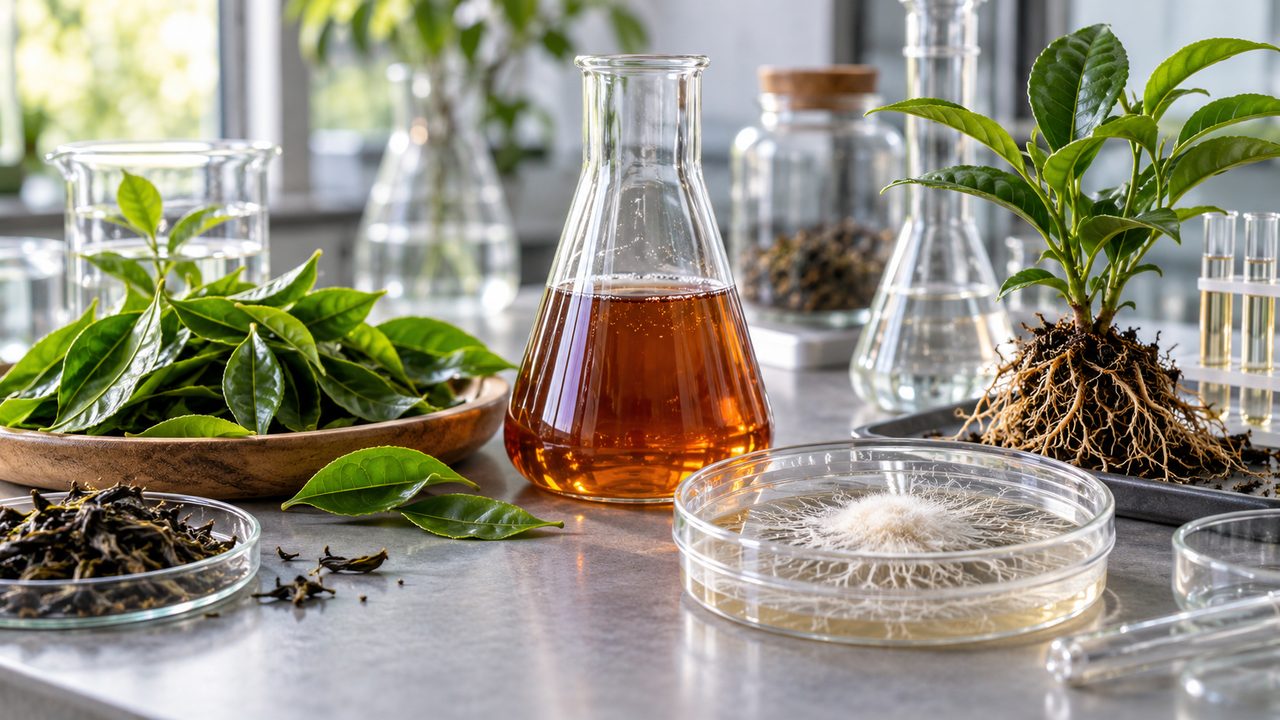
A laboratory study published on 27 October 2026 examined fungi from the root zone of tea plants. The 5 isolated strains could use oligomeric proanthocyanidins as a carbon source. The researchers described 8 fungal metabolites in the process. This is an early biotechnology finding, not evidence of an authorised food or a health effect.
Why proanthocyanidins can be technically difficult
Proanthocyanidins are plant polyphenols. They can contribute to a dry, astringent sensation and bind proteins. In certain raw materials or side streams, a high content can therefore complicate sensory and technical use. The study looked for microorganisms capable of transforming these compounds in a targeted way.
The tea-root zone was not chosen at random. Microorganisms there live for long periods in an environment rich in plant tannins. The team isolated filamentous fungi and grew them in liquid media in which the oligomeric compounds were an important carbon source. Changes in colour and pH served as visible process indicators.
What the laboratory work observed
Untargeted metabolomics and transcriptome analyses showed that degradation was linked to central metabolic pathways. Proteins recovered from outside the fungal cells also degraded procyanidin B2. That supports testing isolated enzymes, rather than living fungal cultures, for controlled processes in the future.
Among the products described, the team highlighted schizostatin formed by a strain of Schizophyllum commune. At the same time, the researchers found transcription patterns linked to fumagillin biosynthesis. This range makes the key point: an analytically interesting metabolite does not automatically make a culture or its end product suitable for food.
Why this is not yet a clean-label process
The work demonstrates metabolic potential under controlled laboratory conditions. It does not yet answer how a real food would taste, how stable the process would be at industrial scale or how unwanted compounds would be completely excluded. Environmental impact, cost and reproducibility across different raw materials also remain open.
Microorganisms, enzymes and novel foods raise separate safety and authorisation questions. EFSA assesses microorganisms used in regulated applications and maintains a qualified-presumption-of-safety system; organisms that are not listed or raise concerns require a full assessment. Novel production processes may also fall under EU novel-food rules.
What consumers can take from this today
- Do not confuse laboratory fermentation with visible mould on food: accidental growth is uncontrolled and the food should be discarded.
- Do not read words such as fermented or natural as an automatic guarantee of safety or health benefits.
- For novel ingredients, look for a precise name, manufacturer information and clear directions for use.
- For tested everyday cooking, use the recipes by ingredient and recipes by meal instead.
Conclusion: an interesting enzyme route at an early stage
The study shows that fungi adapted to tannin-rich environments can use oligomeric proanthocyanidins and provide relevant enzymes. The prospect of developing controlled enzymatic steps is particularly interesting. Before food use, strain selection, toxin risks, process control, sensory quality and authorisation all need to be resolved.
Sources
- npj Science of Food: study of tea-rhizosphere fungi and proanthocyanidins, DOI 10.1038/s41538-026-01227-2
- European Food Safety Authority: Qualified Presumption of Safety for microorganisms
- European Commission: definition and principles for novel foods
- German Federal Institute for Risk Assessment: moulds and mycotoxins in food
Author: Kochzauber editorial team. Updated: 27 October 2026. The findings come from laboratory experiments and are not instructions for fermentation with unknown fungi.