Keeping red cabbage fresh longer: new storage study and safe tips for home
A new study combines antioxidants, precooling and modified atmosphere storage. What the findings mean for supply chains and homes – and how cabbage lasts without specialist equipment.
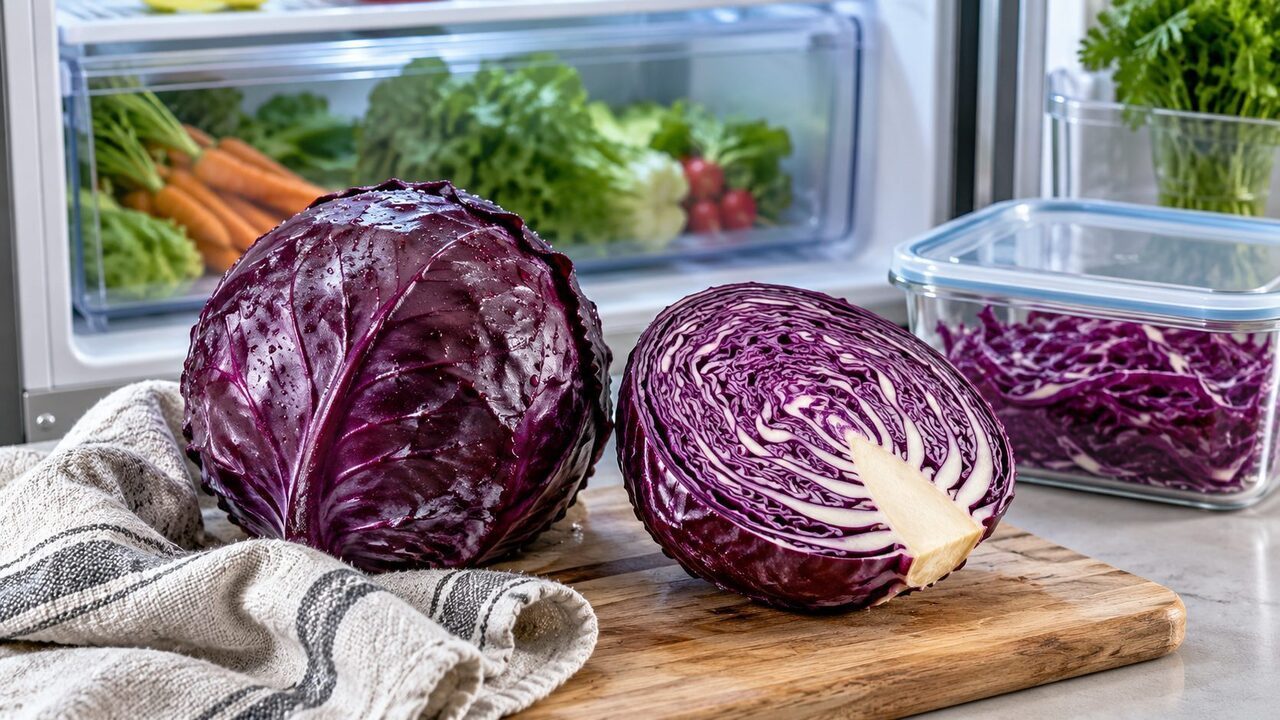
Red cabbage is in its main season from September to December and lends itself to versatile, budget-aware meal planning. A study published on 2 October 2026 shows how precooling, modified atmosphere packaging and food-grade antioxidants may slow quality losses during long storage. Simpler rules still apply at home.
How the experiment was designed
The researchers tested four food-grade antioxidants – ascorbic acid, citric acid, glutathione and alpha-tocopherol – plus an untreated control. Samples were refrigerated conventionally, stored in modified atmosphere packaging, or precooled before modified atmosphere storage.
After 12 weeks the team compared weight loss, firmness, texture, membrane stability, plant compounds and oxidative-stress responses, among other measures. This represents controlled post-harvest and commercial storage, not the normal conditions of a domestic refrigerator.
The most striking result
Citric acid combined with precooling and modified atmosphere storage produced the lowest weight loss: 8.96% compared with 29.46% for the untreated control under the same storage condition. That was a reduction of 69.6%.
With this combination, measured SOD activity reached 49.08 units per mg protein, compared with 25.69 in the corresponding control. Other quality attributes responded differently depending on antioxidant and storage environment, so there was no universally best single treatment.
Why this is not a home experiment
Modified atmospheres, exact concentrations, precooling and hygienically controlled procedures belong to professional experiments. The study does not instruct consumers to soak red cabbage in acidic solutions or seal it in arbitrary airtight packaging.
The authors also say that further testing under commercial conditions is needed. The findings describe potential for supply chains and storage technology, not a guarantee for every cabbage head.
Buying and storing red cabbage well
- Choose a firm, heavy and undamaged head with fresh outer leaves.
- Keep the whole head cool in the vegetable drawer; the German Federal Centre for Nutrition gives about 3 weeks there.
- Wrap cut cabbage in a damp cloth or place it in a suitable box and use it within a few days.
- Keep cabbage apart from apples and other strongly ripening fruit when space allows.
Wash the cabbage only before preparation. Remove wilted or damaged outer leaves and cut off only what you need. A clean cut and cold storage that limits drying protect the remaining portion more effectively.
One head, three economical meals
Plan the head across several meals: start with a finely shredded salad, continue with a pan dish containing potatoes or pulses, and finish with a stew, roasted cabbage or braised red cabbage. The large unit then becomes an advantage rather than a leftover problem.
Surplus can be cooked or blanched in portions and frozen. The actual saving depends on the shop price, the edible amount and waste avoided; seasonal does not automatically mean cheap.
Conclusion: professional technology, simple household logic
The study shows that pretreatment and storage environment interact. At home, an intact head, cool storage, clean cut surfaces and a specific plan for leftovers matter more than specialist treatments. Find more seasonal ideas in our recipes by ingredient and recipes by meal.
Sources and update
- Abo Elmakarem and Mostafa, Scientific Reports: study of red cabbage, antioxidants, precooling and modified atmosphere storage, published on 2 October 2026.
- German Federal Centre for Nutrition: red-cabbage season, buying, preparation and storage.
- German Federal Centre for Nutrition: overview of correct household food storage.
Author: Kochzauber editorial team. Information updated on 3 October 2026. The study treatment is not a household instruction. The cover is an editorial symbolic image.