Sour cherry pomace film: what the new packaging study really shows
A new study turns enzyme-treated sour cherry pomace into pH-responsive biopolymer films. The laboratory findings are interesting but do not yet prove market readiness or PFAS-free food packaging.
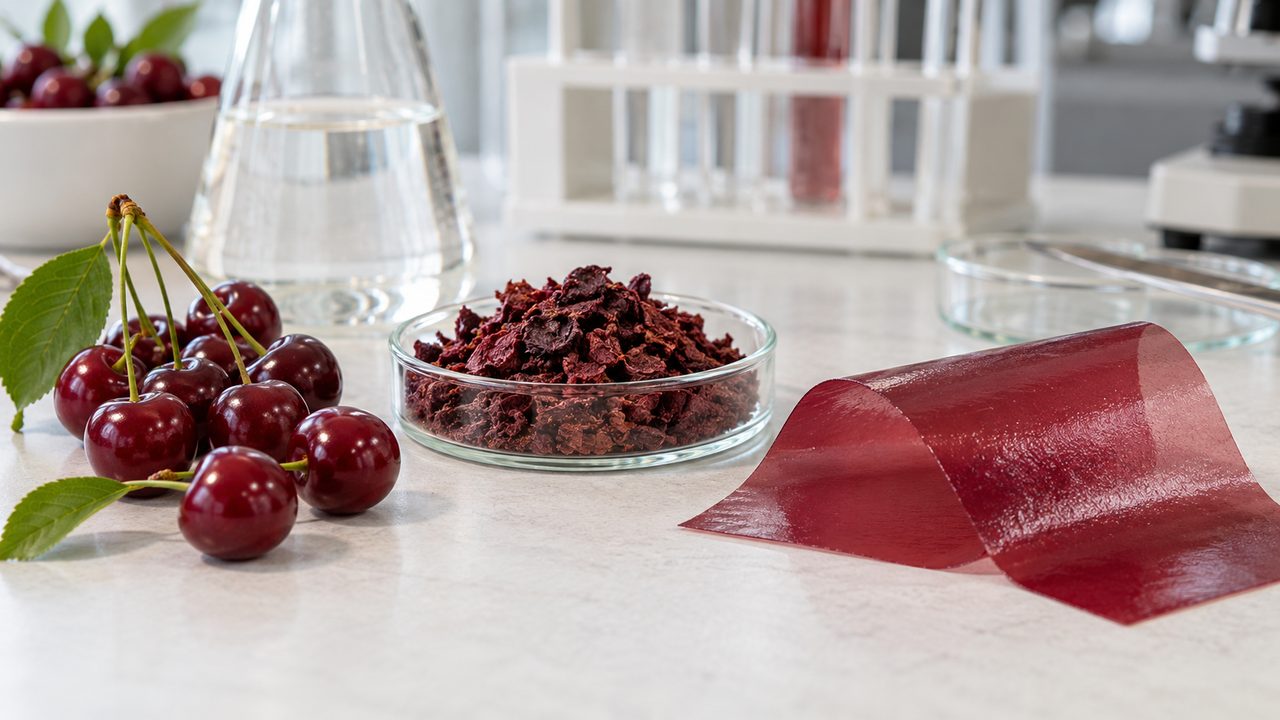
A study published on 28 October 2026 uses sour cherry pomace as a matrix for active and intelligent biopolymer films. The by-product contained 87.35 % carbohydrates, 21.25 mg total phenolics per g dry weight and 1.28 mg anthocyanins per g dry weight. Enzyme treatment produced films with antioxidant activity and pH sensitivity. This is laboratory evidence for a material, not authorization for food contact.
From juice residue to functional film
Pomace remains after fruit processing as a mixture of skins, pulp and other solid matter. The team used polysaccharides present in sour cherry pomace as the film matrix and its natural phenolics and anthocyanins as functional components. According to the study, no external phenolics or colour pigments were added.
Enzyme treatment was intended to modify the polysaccharide matrix and make endogenous phenolic compounds more available. Films from untreated and enzyme-treated pomace were compared. The film made with an enzyme mixture showed the highest antioxidant activity and the clearest pH sensitivity. A future colour change could provide information about changes in packaged food.
Active and intelligent does not automatically mean safe
Active packaging is designed to absorb or release substances to influence food quality or shelf life. Intelligent packaging monitors a condition, for example through colour. Precisely because these materials are more than passive barriers, composition, possible migration, intended foods, contact time and temperature require careful assessment.
The new work characterizes film material and function in the laboratory. It does not establish mass production, storage stability, mechanical resilience in a supply chain or a particular shelf-life gain in real food. Data on odour, taste, industrial scale-up, recycling route and cost are also still missing for a purchasing decision.
Why bio-based is not the same as PFAS-free
Sour cherry pomace is of biological origin. That does not automatically mean a future complete pack is free from PFAS or other substances of concern. The study reports no targeted PFAS analysis. Coatings, adhesives, printing inks, processing aids and additional layers in a finished pack would each need consideration.
Since 12 August 2026, EU limits apply to PFAS in food-contact packaging. The Regulation specifies 25 ppb for any individually targeted PFAS, 250 ppb for the sum of targeted PFAS and 50 ppm for PFAS including polymeric PFAS under the stated conditions. A “PFAS-free” claim therefore needs robust analysis and documentation, not merely a plant-derived feedstock.
What already helps in everyday use
- Use packaging only for the foods, temperatures and purposes stated by the manufacturer.
- Do not repurpose damaged single-use packs or repeatedly heat them.
- For reusable containers, follow microwave, dishwasher and wear instructions.
- Plan food use sensibly: the recipes by ingredient and recipes by meal help use opened supplies.
Conclusion: promising residue, unresolved safety and practical questions
The study shows that sour cherry pomace can provide both a film matrix and colour- or antioxidant-active components. Enzyme treatment improved the measured functions. A genuine food pack, however, still requires migration tests, toxicological assessment, real storage trials, manufacturing data and legal compliance. PFAS freedom was not examined and cannot be inferred from the bio-based approach.
Sources
- Molecules: primary study of sour cherry pomace as a functional biopolymer matrix
- European Commission: legal framework and migration for food-contact materials
- EUR-Lex: EU packaging regulation containing PFAS limits
Author: Kochzauber editorial team. Updated: 29 October 2026. This article describes a laboratory approach; it confirms neither market readiness nor PFAS freedom of packaging.