Recycled PET for food: what the new EFSA review covers
EFSA gives a favourable assessment of EREMA_VACUREMA MPR for food contact, but only under defined process and use conditions. Water, infant formula and oven use are outside its scope.
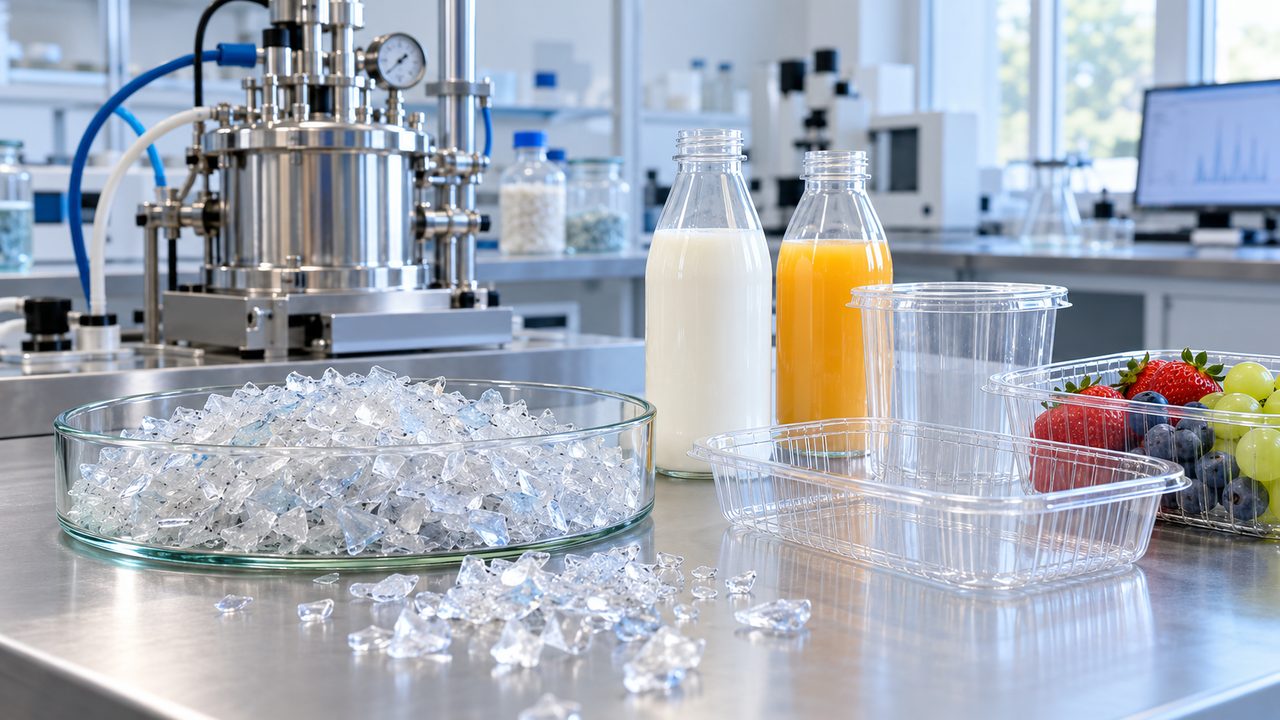
On 28 October 2026, EFSA published its assessment of the EREMA_VACUREMA MPR PET recycling process, EU register number RECYC342. The panel identified no safety concern under the assessed conditions: recycled PET may make up to 100 % of certain food-contact articles. The conclusion applies to this process and its controlled operating data, not automatically to every recycled-PET material or conceivable use.
How the process was assessed
The input consists of washed and dried PET flakes derived mainly from collected food packaging. PET from other consumer applications may account for no more than 5 %. In the critical second process step, the flakes are heated in a continuous reactor under vacuum. Temperature, pressure and residence time must be at least as severe as the conditions used in the validated challenge test.
A challenge test deliberately exposes material to defined surrogate contaminants and measures how effectively the process removes them. EFSA uses this to assess possible unknown contamination conservatively. The result is not a test of every future bottle; it demonstrates that the specified industrial process decontaminates adequately when operated correctly.
Which uses are covered
The assessment covers up to 100 % recycled PET in bottles and containers, including for milk, soft drinks and juices, and trays for fruit, vegetables, raw or cooked meat, dairy products and desserts. It allows long-term storage at room temperature or below, with or without hot filling.
Drinking water, infant formula and human milk are not covered because those uses were not requested. Articles for microwave and conventional ovens are also excluded. This does not automatically mean the material is hazardous there; it means those uses were not part of the submitted evidence or conclusion.
Four limits to the favourable conclusion
- Input must come from legally compliant PET articles; non-food PET remains limited to no more than 5 %.
- The critical vacuum reactor must run at the validated temperature, pressure and residence-time parameters.
- Article shape, food type, storage and temperature must stay within the assessed use conditions.
- The review addresses chemical decontamination; recyclability, climate impact and actual circularity are separate questions.
What consumers can take from it
The words recycled PET alone reveal little about the specific safety assessment. An authorized process, suitable input, continuing quality control and intended use are decisive. Packaging should therefore be heated, reused or refilled only as the manufacturer's instructions permit. Visible damage, strong odours or repurposing are reasons not to keep using a container for food.
Recycled PET does not solve every packaging issue either. Prevention, suitable reusable systems and correct sorting remain relevant. Practical takeaway dishes are available in recipes by meal, while recipes by ingredient can support low-waste planning. Match the container to the food's temperature and storage time.
Conclusion: a process approval, not a blank cheque
The EFSA assessment shows that mechanically recycled PET can return to numerous food packages under tightly controlled conditions. The validated plant, clean input and authorized use are decisive. Reading the news as blanket safety for every rPET item, drinking-water bottle or oven application would go beyond the evidence.
Sources
- EFSA Journal: safety assessment of the EREMA_VACUREMA MPR process
- European Commission: plastic recycling for food contact
- EUR-Lex: Regulation (EU) 2022/1616 on recycled plastics
Author: Kochzauber editorial team. Updated: 30 October 2026. The assessment is process- and use-specific and does not replace manufacturer instructions.