Bioplastics in landfill: PHB, PLA and PBAT degrade very differently
A new long-term study compares four plastic films under anaerobic landfill conditions. The result warns against reading “biodegradable” as a disposal instruction.
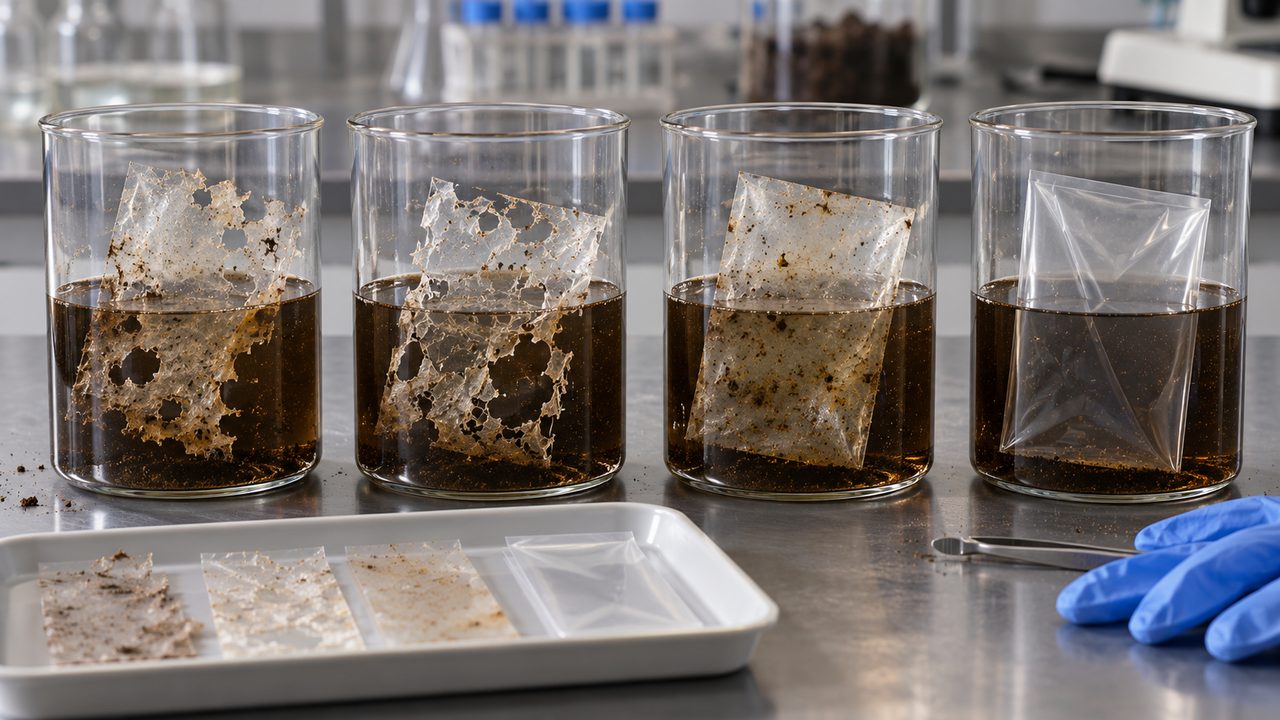
A study published on 20 October 2026 examined PHB, PLA, PBAT and conventional LDPE for up to 320 days in warm, oxygen-free landfill leachate. The polymers behaved completely differently. The key lesson for food packaging is that a biodegradability term describes conditions; it does not automatically give the correct disposal route.
PHB fast, PLA slow, PBAT almost unchanged
In the experiment, PHB reached 99.9% mineralisation within 17 days. PLA reached 83.6% after 320 days. PBAT remained largely stable at 2.7%, while the LDPE comparison reached 0.4%. The measurement tracked conversion of polymer carbon to biogas, not merely visible fragmentation.
For PHB and PLA, activity was concentrated in biofilms on the polymer surface. Genetic blueprints for potential degrading enzymes were present in many microorganisms, but only some were active. The researchers conclude that polymer chemistry and the microbial environment jointly determine the outcome.
Why this is not a ranking of packaging
The team tested defined films made from individual polymers under one laboratory regime with landfill leachate. Commercial food packaging may contain blends, colourants, barriers, adhesives or different thicknesses. Temperature, moisture, oxygen, microorganisms and treatment time also differ among composting, digestion, landfill and the open environment.
The results therefore do not show that every PHB pack will disappear quickly or every PBAT pack will remain unchanged. Nor do they assess food safety, the full environmental footprint, recyclability or release during use. The experiment concerns only anaerobic degradation under the selected conditions.
Four terms that do not mean the same thing
- Bio-based describes the origin of the carbon; a bio-based plastic need not be biodegradable.
- Biodegradable means that a material can be broken down by microorganisms under defined conditions; place and time are crucial.
- Compostable refers to the requirements of a specific standard, often for industrial plants, not automatically to a garden compost heap.
- Recyclable concerns a suitable collection, sorting and recovery route and does not follow from biodegradability.
The European Commission likewise stresses that bio-based, biodegradable and compostable are separate properties. Green design or one marketing term therefore answers neither the feedstock question nor the disposal question.
How to dispose of such food packaging in Germany
Germany's Environment Agency says plastic packaging belongs in the yellow bin, yellow bag or the local packaging collection, even when marketed as bio-based or biodegradable. It does not belong in the organic-waste bin and must never be discarded in the environment. Local instructions take priority.
Exceptions may apply to approved organic-waste caddy liners where the municipality accepts them. That does not extend to cups, trays, films or cutlery. When unsure, check the packaging and local waste guidance instead of relying on the material name.
Everyday relevance and conclusion
Avoiding unnecessary single-use packaging and planning food to demand is often the most effective step. Kochzauber's recipes by ingredient help use supplies, while recipes by meal support needs-based shopping.
Conclusion: PHB, PLA and PBAT did not form one uniform group in the same study. That makes “biodegradable” a testable technical statement, not permission to use the organic bin, compost heap or nature. For consumers, the local sorting rule remains decisive.
Sources
- Nature Communications: anaerobic degradation of PHB, PLA and PBAT, 20 October 2026
- German Environment Agency: FAQ on bio-based and biodegradable plastics, updated 15 August 2023
- European Commission: EU framework for bio-based, biodegradable and compostable plastics, 2022
Author: Kochzauber editorial team. Updated: 21 October 2026. Packaging labels and local waste rules determine the disposal route.