Pea, faba bean or whey protein? Small acute trial compares the response
A randomised crossover trial found no meaningful difference in the acute growth-hormone response of healthy women. Its conclusion remains narrowly limited.
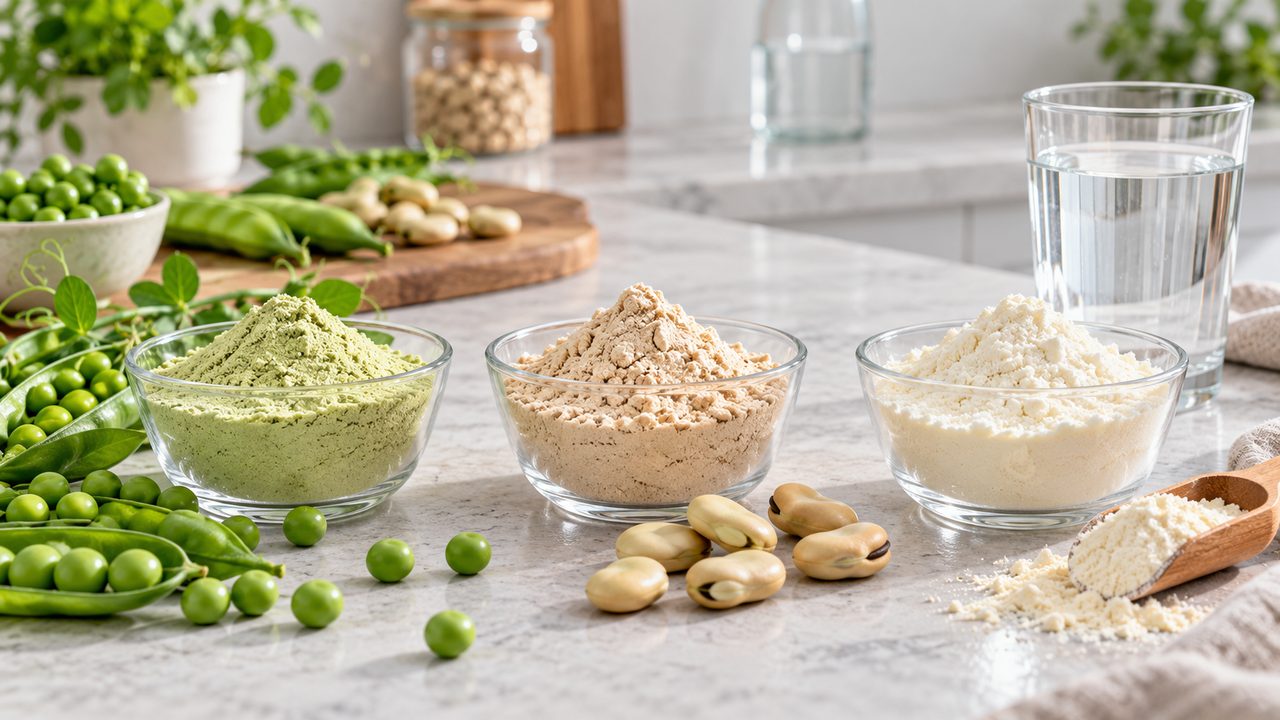
A randomised, double-blind crossover trial published on 16 October 2026 studied 16 healthy women. In four experimental conditions, they received pea, faba bean or whey protein isolate at 0.6 g protein/kg body weight in 400 ml water, or 400 ml water alone. Blood values were followed for 3 h. Growth-hormone responses did not differ significantly between protein sources.
How the trial was designed
Participants had a median age of 28 years, with a range of 21–38 years. Median body mass index was 23, with a range of 22–24. Because each participant completed every condition, the researchers could compare acute responses within the same person.
They measured growth hormone, insulin, glucose and amino acids after intake. The serving was linked to body weight and delivered as isolated protein in water. This does not mirror a normal mixed meal or automatically represent a standard commercial protein-powder serving.
What 'comparable' actually means here
Despite differences in amino-acid composition, the researchers found no statistically significant difference in growth-hormone secretion. They also judged the observed gaps in this experiment not to be physiologically meaningful. This is an interesting indication that the two plant isolates can produce a short-term response similar to whey.
The conclusion applies only to the acute endpoint studied. Growth hormone is not a direct measure of muscle gain, satiety, long-term health or overall protein quality. Taste, tolerance, digestibility and the supply of all indispensable amino acids were not settled by this outcome either.
Sample size is the central limitation
With 16 participants, the study was small. The authors themselves call the findings preliminary and request larger investigations. Men, older people, adolescents and people with medical conditions were not represented. A non-significant difference therefore cannot establish universal equivalence.
The paper is also an accepted manuscript before final copy-editing and typesetting. Its DOI will remain stable, but details of presentation may still change in the final version.
What still makes sense in everyday cooking
- Do not confuse protein needs with a single hormone value: food across the whole day matters.
- Combine pulses with grains or potatoes: their amino-acid patterns can complement one another.
- Treat powders as ingredients: the ingredient list, serving, price and personal tolerance still matter.
- Use variety: peas, beans, lentils, grains, nuts and seeds provide more than protein alone.
EFSA gives a reference intake of 0.83 g protein/kg body weight per day for healthy adults. Ideas for plant-based meals are available under recipes by ingredient and recipes by meal. Individual requirements can differ.
Conclusion: an interesting signal, not a ranking
The acute trial offers an encouraging but narrow signal for pea and faba bean protein. It found no meaningful difference in the measured growth-hormone response compared with whey. The study is too small and too short to support claims about muscle gain, long-term effects or complete interchangeability.
Sources
- International Journal of Food Science and Technology: randomised crossover trial, published 16 October 2026
- German Nutrition Society: reference values and context for protein sources
- European Food Safety Authority: dietary reference intake for protein
Author: Kochzauber editorial team. Updated: 17 October 2026. This article reviews a small acute trial and does not replace individual nutrition advice.