Just Cut Off the Mould? What the New BfR Knowledge Check Shows
Almost one in three people would only remove the affected part of mouldy fruit or vegetables. Why that is often insufficient and which exceptions the BfR identifies.
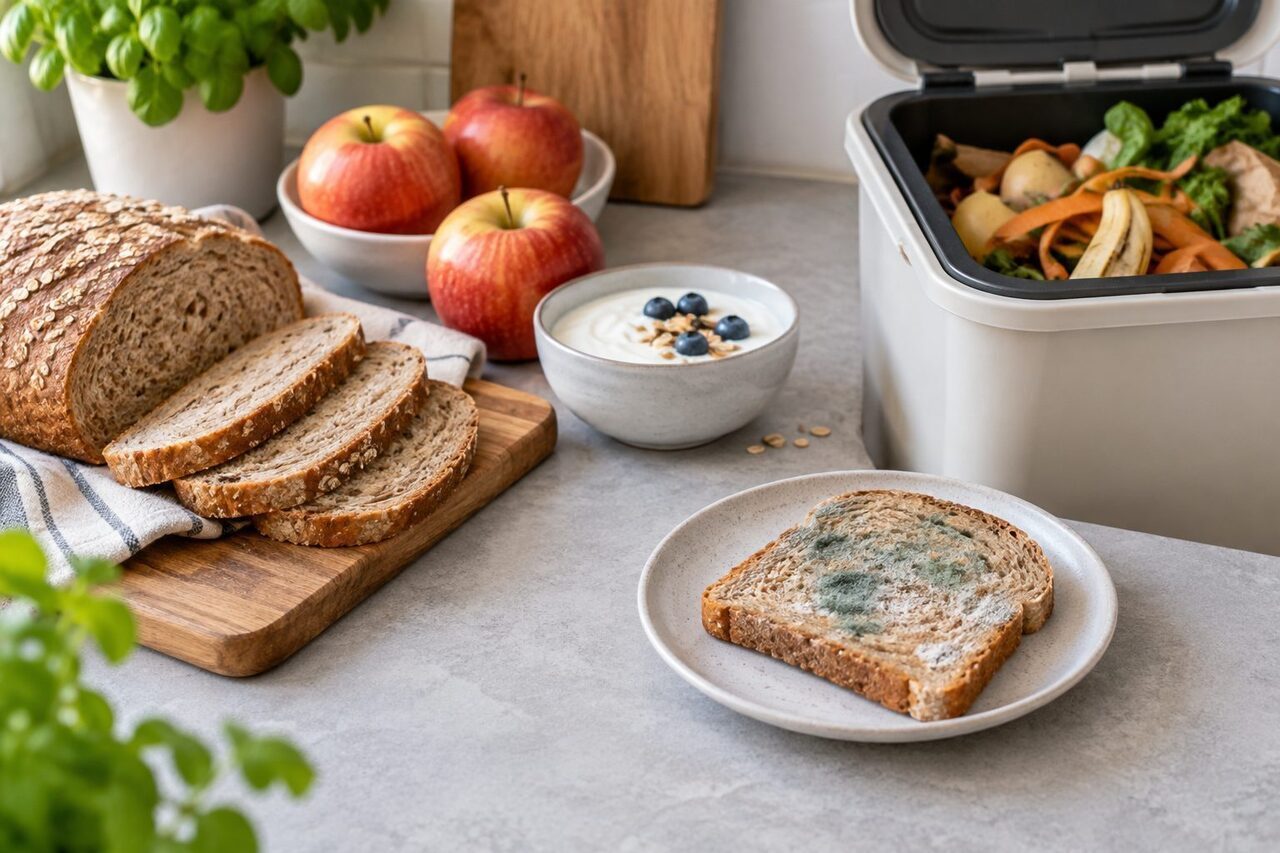
In short: Almost one in three people would only remove the affected part of mouldy fruit or vegetables. Why that is often insufficient and which exceptions the BfR identifies.
The survey measures knowledge, perception and self-reported behavior. It is not a measurement of the actual mycotoxin burden on German households and does not say that every molded food automatically makes you sick. Its usefulness lies in making concrete gaps in knowledge visible.
What the BfR examined
From 14 to 30 April 2026, the BfR surveyed German-speaking Internet users aged 16 and over in private households. The random sample from an online panel was quoted according to gender, age, education and federal state and then weighted.
Many basic rules are known: 94.8 percent stated to dispose of molded food immediately and not to leave it open. However, the behaviour of the specific product became more inconsistent. Dimmed yoghurt and molded meat each wanted to throw away more than 95 percent completely. In fruit and vegetables, 30.6 percent tended to cut away, in cheese 22.3 percent.
At the same time, 40.1 percent felt rather or very poorly informed about the health risks. Only 46.9 percent knew that mycotoxins were not reliably rendered harmless by strong heating. 27.4 percent thought this was possible falsely, while another 25.7 percent were unsafe.
Why visible mould is only part of the problem
The furry or discoloured surface is the visible growth of the fungus. However, fungus threads can spread deeper in the food than the eye recognizes. Some molds also form mycotoxins. Depending on the type, quantity and duration of the intake, these substances can have different health effects.
The BfR emphasizes that almost all the relevant mycotoxins are heat and acid stable. Cooking, roasting, baking or insertion in acid does not remove them reliably. Compote does not make a safe rest from a molded apple, and molded bread cannot be saved by toasts.
This does not mean that any food is moldy with a pressure or discoloration. Typical features such as a whitish, greenish, black or yellowish, powdery or furry surface and an overall suspicious condition are decisive. In case of uncertainty, throwing away is safer than trying.
Which foods must be discarded completely
Especially in water-rich and soft foods, mold can spread invisibly. The BfR mentions, among other things, compote, fruit juice, jam, jelly, fruit, milk and dairy products as well as bread.
- Bread and baked goods: Dispose of the whole pack, even if other slices still look normal.
- Yoghurt, curd and soft cheese: Do not drain, but dispose of completely.
- Soft fruits and vegetables: Not only prune the molded berries, peaches, tomatoes or cucumbers.
- Jam and compote: Do not remove the covering and continue to use the rest.
This is an important limit for the leftover kitchen: saving food makes sense as long as appearance, smell, storage and product safety are right. Visible mold should not be concealed by a new recipe. Ideas for impeccable pantry staples offer Kochzauber among recipes according to ingredients and one-pot dishes. (Recipes by ingredients)
The narrow exceptions identified by the BfR
The BfR calls air-dried sausages with noble mould and air-dried hams as exceptions. There, infected parts can be generously removed; cold cuts do not belong to it. In the case of nuts, eye-catching individual pieces are to be sorted out.
Wanted precious mold at Brie, Camembert, Roquefort or certain salamis is part of the production and not to be equated with accidental spoilage. Such products should be packaged separately so that the desired mold does not pass to other foods. If an untypical covering occurs in a place where it does not belong, the general assumption is "This is only noble mold" not a safe decision.
How to prevent mould at home
- Buying suitable quantities: Use fresh food quickly and invest large stocks only if the storage conditions are right.
- Store clean, dry and cool: moisture and heat promote the growth of many moulds.
- Care for bread box: remove crumbs and clean the box regularly; the BfR recommends vinegar water once a week.
- Clean refrigerator after infestation: Do not leave the moldy open and check neighboring foods.
- Shop small spices: Do not store dried spices for years, but store them dry and consume them in manageable quantities.
Those who store food in a clear way will also recognize what needs to be consumed in the past. A firm place in the refrigerator helps sensitive products; bread stays good in a clean, dry container for longer, depending on the weather.
What the survey does not prove
The percentages show what participants stated in an online survey. They do not prove that all people behave exactly in everyday life. Likewise, the survey does not provide a new dose-effect assessment of individual mycotoxins and no frequency of concrete poisoning.
The health classification remains dependent on material and quantity. Therefore, the article does not combine a single molded slice of bread with a safe disease. The recommendation for action is precautionary: Visibly infected, soft food can be disposed of completely, because invisible spread and heat-stable toxins cannot be reliably tested at home.
Conclusion: Cutting it off does not save soft foods
The new knowledge check shows a clear gap between general intent and concrete decision. Most people say that they throw away mold. However, in the case of fruit, vegetables and cheese, only the visible part is removed more often.
For everyday kitchens, the rule is simple: in the case of bread, soft fruit and vegetables, dairy products, compote or jam, dispose of all the food concerned. Heating does not reliably make mycotoxins harmless. Prevention is best done with suitable quantities of shopping, dry and cool storage as well as clean bread and fridge.
Sources and status
- Bundeszentrum für Ernährung: Health risk from molds – Study shows gaps in knowledge, news of 16 September 2026. (Health risk from molds – study shows knowledge gaps)
- Federal Institute for Risk Assessment: Perception of Mycotoxins in Food, Population Survey, DOI 10.17590/20260826-114754-0.
- Bundesinstitut für Risikobewertung: Molds in food – Health risks and how to avoid them, FAQ of 11 March 2026. (Moulds in food – health risks and how to avoid them)
- Federal Center for Nutrition: Store food properly, background to household storage.
Author: Kochzauber editorial team. Information and updating status: 18 September 2026. The article reproduces official precautionary instructions and does not replace individual medical advice. The title image is an editorial symbol.