Macadamia press cake as a protein source: what a new study found
A laboratory team made protein from the residue of macadamia-oil production functional in very oil-rich emulsions. The result is technically intriguing, but it is not a finished food.
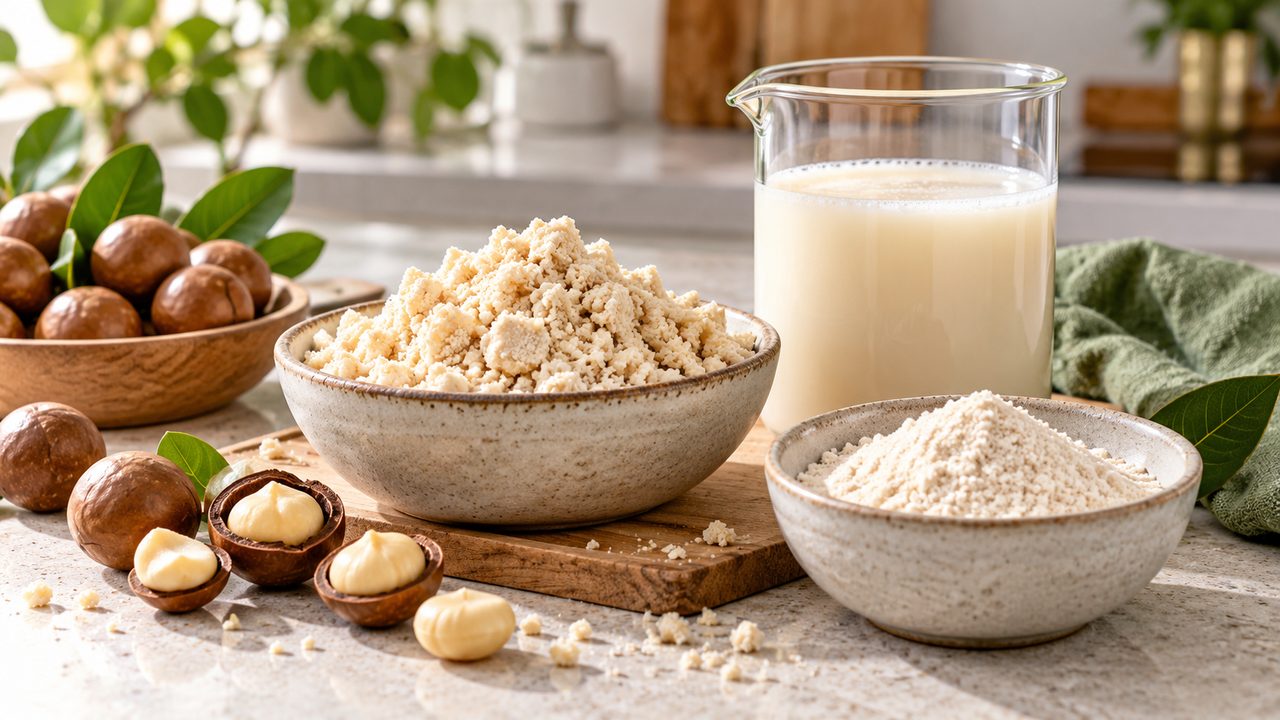
A study presented on 24 October 2026 examines protein from macadamia press cake, the material left after oil extraction. In the laboratory, phosphorylation raised measured solubility from 14.01% to as much as 96.78%. The treated protein stabilised an emulsion containing 80% oil for 30 days. These are functional data for product development, not proof of a market-ready or healthier food.
What the research team changed
Macadamia press cake contains protein, but it dissolves poorly in water. The researchers treated a dispersion containing 4% protein with sodium tripolyphosphate or sodium trimetaphosphate. The best-performing variant used 5% sodium tripolyphosphate at pH 9.0 and 45°C for 2 hours. Excess salts were then removed and the protein was freeze-dried.
The attached phosphate groups gave the protein particles a stronger negative charge, helped them disperse more finely and improved their adsorption at the boundary between oil and water. This is a targeted chemical modification. The study does not show that untreated press cake has the same effect at home or can be used directly as a kitchen ingredient.
Why the emulsion is interesting
At 75% oil, both untreated and modified protein formed gel-like systems. At 80% oil, the emulsion with untreated protein separated visibly, whereas the treated version showed no visible separation after 30 days. Such highly concentrated emulsions may be relevant to fillings, spreads or the encapsulation of sensitive ingredients.
The broader idea is circularity: a currently underused side stream might become a functional ingredient. Whether that is environmentally and economically sensible depends on the whole process, including chemicals, water, purification, drying and yield. The laboratory study did not assess that balance.
What remains unanswered
Selected formulations were tested under controlled laboratory conditions. Sensory quality, digestion, shelf life in a real food, production costs and acceptance were not the main focus. The precise point at which an emulsion becomes unstable is also not established by the tested levels of 75% and 80%.
Macadamia is a tree nut. If it becomes an ingredient in food, safe production and clear allergen labelling remain essential. The EU requires mandatory allergens to be emphasised in the ingredient list. A novel protein source does not remove that obligation.
What consumers can do with this today
- Do not equate press cake or protein powder with whole macadamia nuts: processing and properties differ.
- Check the complete ingredient list and clearly emphasised allergens when buying foods with novel ingredients.
- Use established plant proteins such as beans, lentils or peas at home; Kochzauber’s recipes by ingredient provide practical ideas.
- Prepare everyday emulsions with tested recipes and fit them into the week through the recipes by meal.
Conclusion: promising function, early development
The study convincingly shows that a macadamia press-cake protein can be made far more soluble and useful as an emulsion stabiliser in the laboratory. It proves neither market readiness nor a nutritional benefit. Its importance is the new technical route for a side stream, with scaling, environmental impact, flavour and allergen management still unresolved.
Sources
- Current Research in Food Science: study on phosphorylated macadamia protein isolate, DOI 10.1016/j.crfs.2026.101608
- Scienmag: publication report of 24 October 2026
- European Commission: food and allergen labelling in the EU
Author: Kochzauber editorial team. Updated: 26 October 2026. The findings come from a laboratory study and do not establish market readiness or health effects.