Root-crop proteins: enzyme choice changes peptide diversity
A new study examines proteins from ginger, purple carrot, radish and sweet potato. The plant matters, but so does the enzyme used to process it.
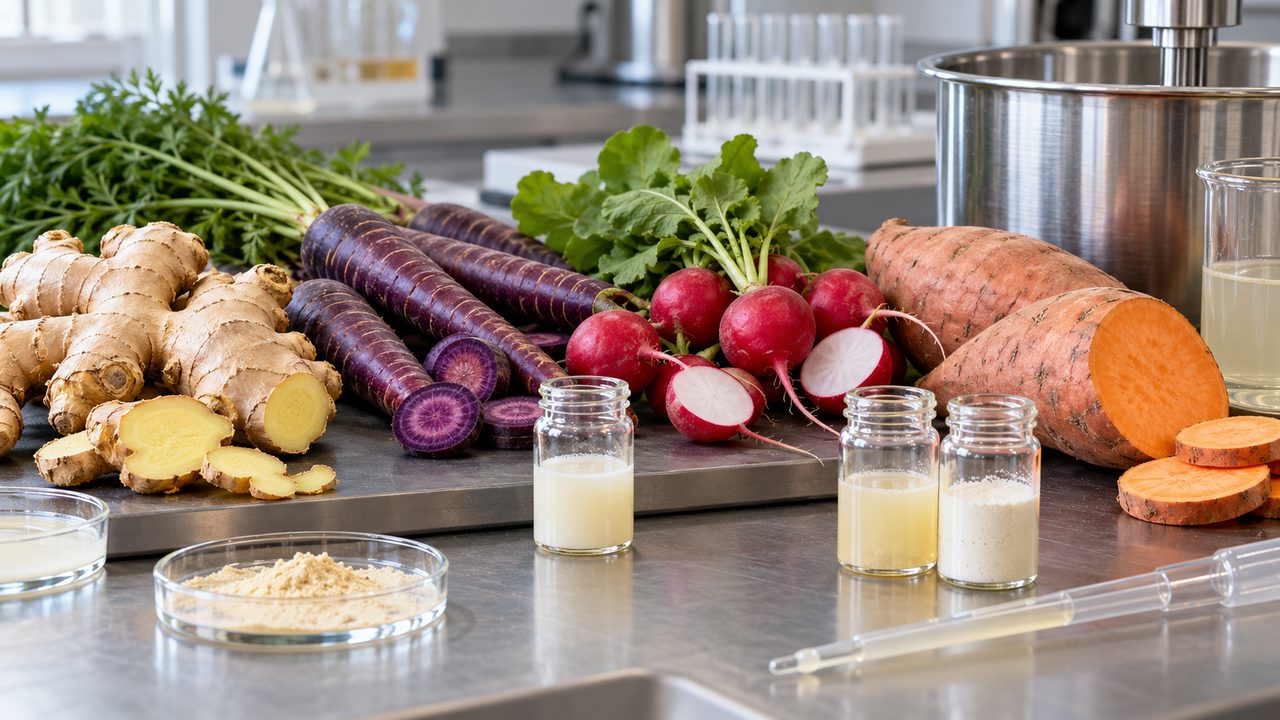
An open-access laboratory study of proteins from ginger, purple carrot, radish and sweet potato appeared on 20 October 2026. The team compared 7 commercial proteases in single, concurrent and sequential treatments. The work identifies a technical control for new plant ingredients, but it does not yet describe a ready-to-eat product.
10,049 peptides from 15 processing variants
Across all 15 hydrolysis conditions, the team identified 10,049 different peptides by LC-MS/MS. Of these, 9,198 appeared under only one condition. Enzyme choice therefore opened different regions of the plant proteins rather than producing the same mixture in different amounts.
Alcalase produced a mean 674 ± 290.7 identified peptides per replicate. Trypsin produced 107.6 ± 67.4, a 6.3-fold difference. Importantly, the number of identified sequences is not a measurement of the protein or peptide mass actually recovered.
An enzyme mixture is not automatically better
Individual broad-acting enzymes produced particularly many identifiable peptides in this experiment. Sequential enzyme combinations, meanwhile, yielded longer sequences on average: 13.9–15.5 amino acids versus 10.7 for trypsin. Hydrophobicity and terminal-residue profiles also changed substantially.
That matters for ingredient development because length, charge and affinity for water or fat may later influence solubility, emulsions, flavour and processing. The study did not test those applications in a food, however. It first maps the physicochemical landscape of the mixtures.
Four important study limitations
- Each enzyme ran under its own optimal conditions, so differences reflect both the enzyme and its processing environment.
- Only a limited protein database was available for sweet potato, restricting peptide identification for that matrix.
- Predicted biological activities were not confirmed in people, animals or a finished food.
- Taste, allergenicity, digestibility, production yield, cost and shelf life were outside the study's scope.
The authors therefore explicitly present the computer predictions as a starting point for further testing, not as evidence of health effects. Claims such as antioxidant, blood-pressure-lowering or anti-inflammatory would be premature for a product on the basis of this investigation.
What this could mean for future ingredients
The interesting point is not a supposed superfood but the process concept: proteins from familiar roots and rhizomes can be converted into very different peptide mixtures. Developers could eventually choose an enzyme for the desired physical profile before testing solubility, texture or function in real foods.
Whether an extract developed this way counts as a novel food in the EU depends on its source, manufacturing method and history of use. New foods may require a safety assessment and authorisation before sale. A laboratory publication does not replace that process.
Everyday relevance and conclusion
The study changes nothing in today's kitchen: ginger, carrots, radishes and sweet potatoes remain ordinary ingredients, not newly validated protein supplements. Kochzauber's recipes by ingredient show practical uses, while recipes by meal support balanced planning.
Conclusion: the study expands the toolkit for plant protein and peptide ingredients. It convincingly shows that enzyme choice and sequence steer composition. Product trials and, where needed, regulatory review must still establish whether safe, appealing and economical foods can result.
Sources
- European Food Research and Technology: plant-protein study, 20 October 2026
- EFSA: procedure and scientific requirements for novel foods, reviewed 6 May 2026
- European Commission: novel-food authorisation under Regulation 2015/2283
Author: Kochzauber editorial team. Updated: 21 October 2026. This article explains laboratory findings and makes no health claims.