Fermented cili in black-wheat bread: what the laboratory comparison found
A new baking study combines fermented cili fruit with white and black wheat. It measures more fibre and bioactive compounds but does not prove a health benefit.
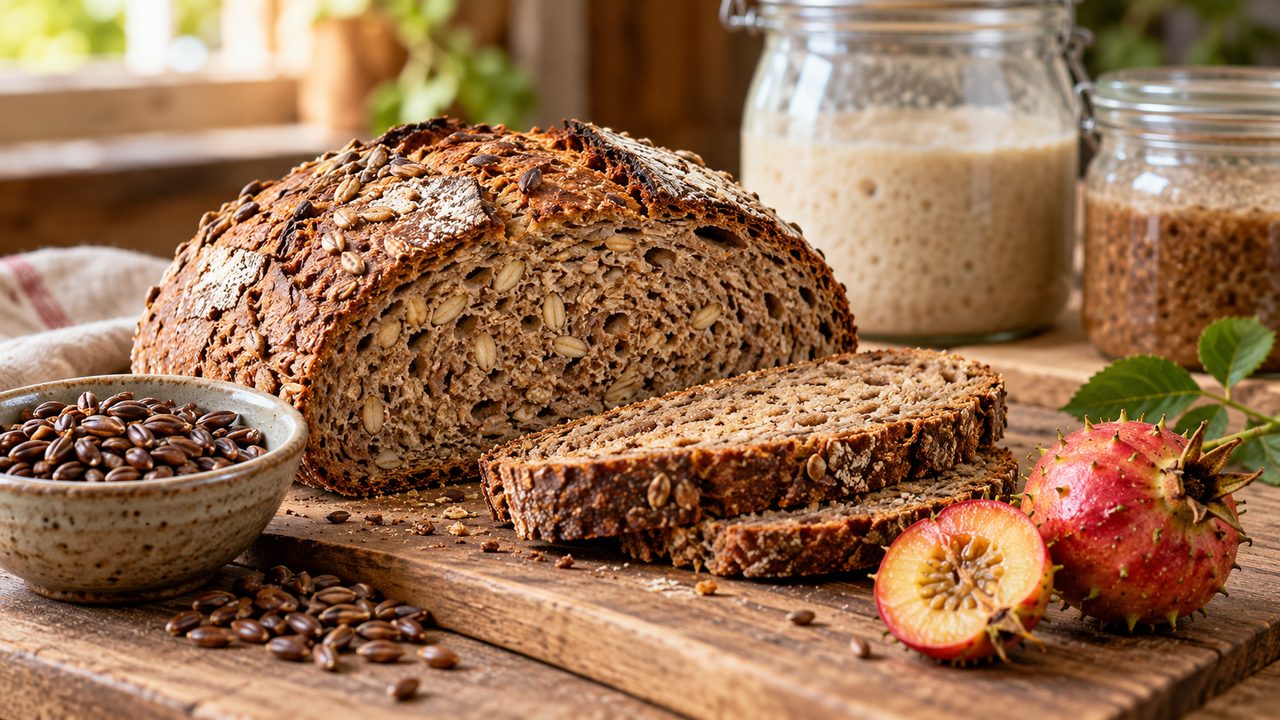
A study published on 17 October 2026 fermented cili fruit (Rosa roxburghii) with Bacillus subtilis and Lactiplantibacillus plantarum and tested it as a bread ingredient. The fermented component represented 30% of the flour weight. The researchers compared white-wheat bread with bread made from white and black wheat in a 50:50 ratio, both with and without the cili ingredient.
How the baking experiment was designed
Black wheat naturally contains more outer grain layers and plant pigments, but it can produce a denser loaf. The researchers therefore examined enzyme activity in the dough, loaf volume and crumb firmness, along with several composition and laboratory markers in the finished bread.
This was a controlled product experiment, not a human trial. It describes these precise formulations and this manufacturing process. Whether a bakery, another batch of cili or longer storage would produce a comparable result would need to be tested separately.
More measured compounds do not prove a health benefit
Compared with the white-wheat control bread, the black-wheat bread with fermented cili contained 9.46 rather than 3.01 g total dietary fibre per 100 g dry weight. Soluble fibre was 2.29 rather than 0.30 g/100 g dry weight. GABA, phenolics and flavonoids were also higher in the laboratory analysis.
Such analyses describe composition. They do not establish better absorption in the body or an effect on wellbeing or disease. Claims such as “high fibre” and health statements have defined conditions in the EU; a single research prototype cannot automatically be described as health-promoting.
The crumb became somewhat less firm
Compared with black-wheat bread without cili, measured crumb firmness fell from 493 to 410 g. Specific volume was 4.17 rather than 3.94 ml/g; this difference was not statistically significant. In this experiment, the ingredient therefore improved firmness in particular without demonstrating a reliable volume effect.
Sensory data from a large consumer group are missing. Colour, acidity, aroma and aftertaste may decide whether a loaf is accepted in daily life. Shelf life and the safety of a standardised fermentation process would also require testing before commercial use.
What actually helps when buying bread
- Look for wholegrain flour or wholegrain meal in the ingredient list instead of relying on dark colour.
- Compare fibre declarations per 100 g and interpret serving sizes realistically.
- Do not confuse fermented with probiotic: baking heat and processing alter microorganisms.
- Assess new ingredients by taste, tolerance, price and transparent labelling.
Kochzauber's recipes by ingredient and recipes by meal offer practical ideas for home cooking. The German Federal Centre for Nutrition notes that wholegrain products are good fibre sources, but visible seeds or a dark colour alone do not prove that bread is wholegrain.
Conclusion: an interesting formula with early evidence
The study shows that fermented cili can partly offset technical drawbacks of black-wheat bread and change its measured composition. That is relevant to product development. Human trials, broad sensory testing and robust manufacturing and storage data are still missing for health claims, everyday suitability and market readiness.
Sources
- Foods: original fermented-cili ingredient study, published 17 October 2026
- German Federal Centre for Nutrition: dietary fibre and identifying wholegrain products
- European Commission: rules for nutrition and health claims
Author: Kochzauber editorial team. Updated: 18 October 2026. This article reviews a product experiment and makes no claim of a health effect.