Cooking oil under prolonged high heat: what a new study means at home
A study compared cold-pressed and refined oils under extreme continuous heat. Its 230-degree condition is not a normal recipe, but it supports careful temperature control.
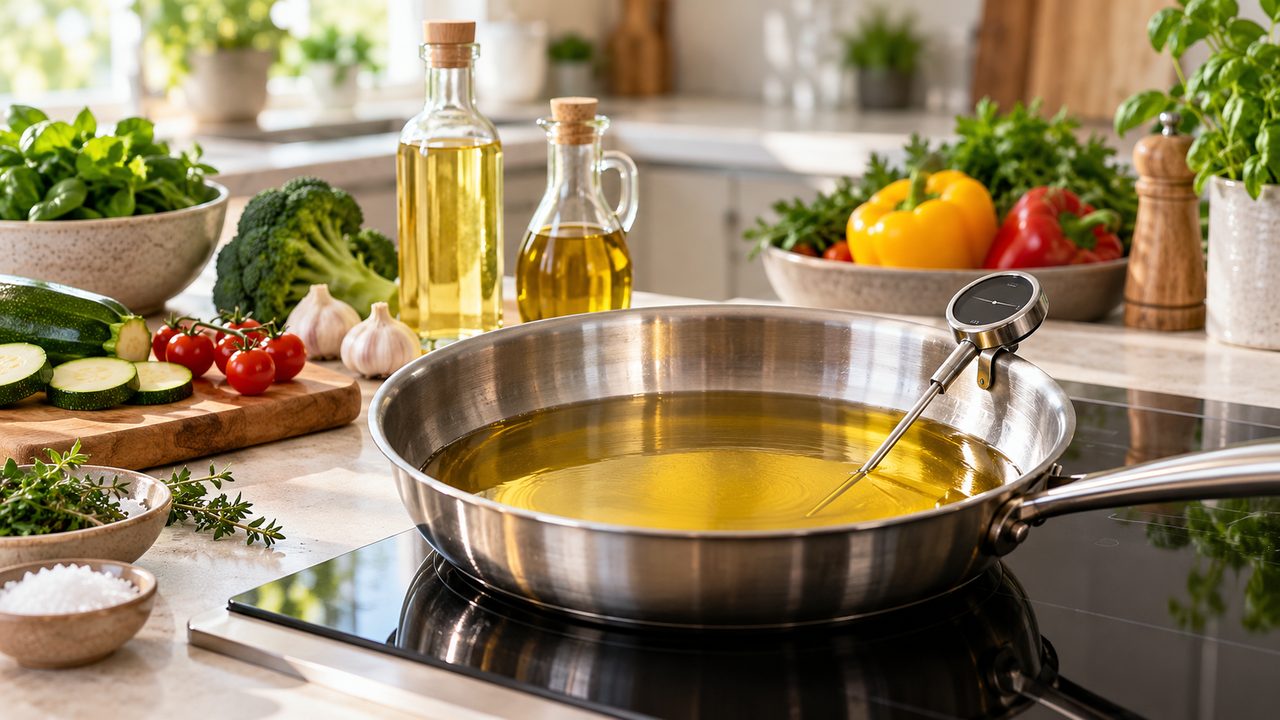
A study published on 23 October 2026 exposed 12 cooking oils — 7 cold-pressed and 5 refined — to continuous heat at 230 ± 5°C for 0, 1, 2 and 4 hours. After 4 hours, measured trans fatty acids in soybean oil rose from 0.76% to 5.88%, while coconut oil stood at 0.38%. The design represents extreme prolonged stress, not ordinary pan-frying at home.
How the investigation was designed
The researchers tested cold-pressed groundnut, sunflower, rice-bran, palm, mustard, sesame and coconut oils, alongside refined groundnut, sunflower, rice-bran and palm oils and refined soybean oil. Commercial samples of each oil were pooled. The study therefore compares oil types under the same conditions, but not individual brands.
Each 100 ml portion was heated in an open stainless-steel vessel. The team analysed fatty-acid profiles, peroxide value, free fatty acids, acid value, conjugated dienes and trienes, colour and other properties. Some indicators rose and others fell; under severe heat, a falling peroxide value can also mean that primary oxidation products have already broken down further.
What the findings do and do not show
Cold-pressed groundnut, sunflower, rice-bran and palm oils retained more polyunsaturated fatty acids after 1 hour, yet lost more after 4 hours than their refined counterparts. All oils became progressively darker. The study therefore found no simple divide in which cold-pressed is always better or refined is always more stable.
Coconut oil changed least on several measures. That is not a blanket nutrition recommendation, because heat stability is only one selection criterion; fatty-acid profile, flavour, production and intended use also matter. The researchers studied oil under a very high constant laboratory temperature, not a finished fried meal.
A practical temperature rule
The German consumer advice service suggests 130 to 140°C for pan-frying and 160 to 170°C for deep-frying, while advising that oils should preferably not exceed 200°C. The German risk institute recommends 165 to 175°C for deep-frying: as briefly as possible, but as long as necessary. These ranges sit well below the study condition of 230 ± 5°C.
Smoke, a harsh smell or watering eyes indicate overheating. The oil and food prepared in it should then not be used further. Refined oils or products explicitly labelled for frying are generally more practical for high heat, while delicate aromatic oils are better added to finished dishes.
Four steps to reduce heat stress
- Choose an oil for the cooking method and follow the manufacturer’s heat guidance.
- Do not leave a pan or fryer unattended and use a thermometer when useful.
- Dispose of overheated oil, or oil repeatedly cooled and reheated, without pouring it down the drain.
- Plan moderate-heat dishes through the recipes by meal and use opened oils in time with the recipes by ingredient.
Conclusion: temperature matters more than the label
The new study shows how strongly prolonged heat can alter cooking oils and how differently oil types respond. It gives neither a free pass to one oil nor a direct household ranking. The robust lesson is simpler: match the oil to the method, stay well below extreme heat and treat smoke as a clear stop signal.
Sources
- Frontiers in Nutrition: study of continuous high-temperature treatment of cold-pressed and refined cooking oils, 23 October 2026
- German consumer advice service: which cooking oil suits which use?, updated 5 August 2026
- German Federal Institute for Risk Assessment: guidance on deep-frying and temperature control
Author: Kochzauber editorial team. Updated: 26 October 2026. The laboratory condition of 230 ± 5°C is not a recommendation for home cooking; product guidance and controlled temperatures remain decisive.