Carrageenan film absorbs more moisture: what the new packaging prototype can do
A new materials study combines carrageenan and gallic acid in a hydrogel film for moisture absorbers. The laboratory effect is clear, but practical use is open.
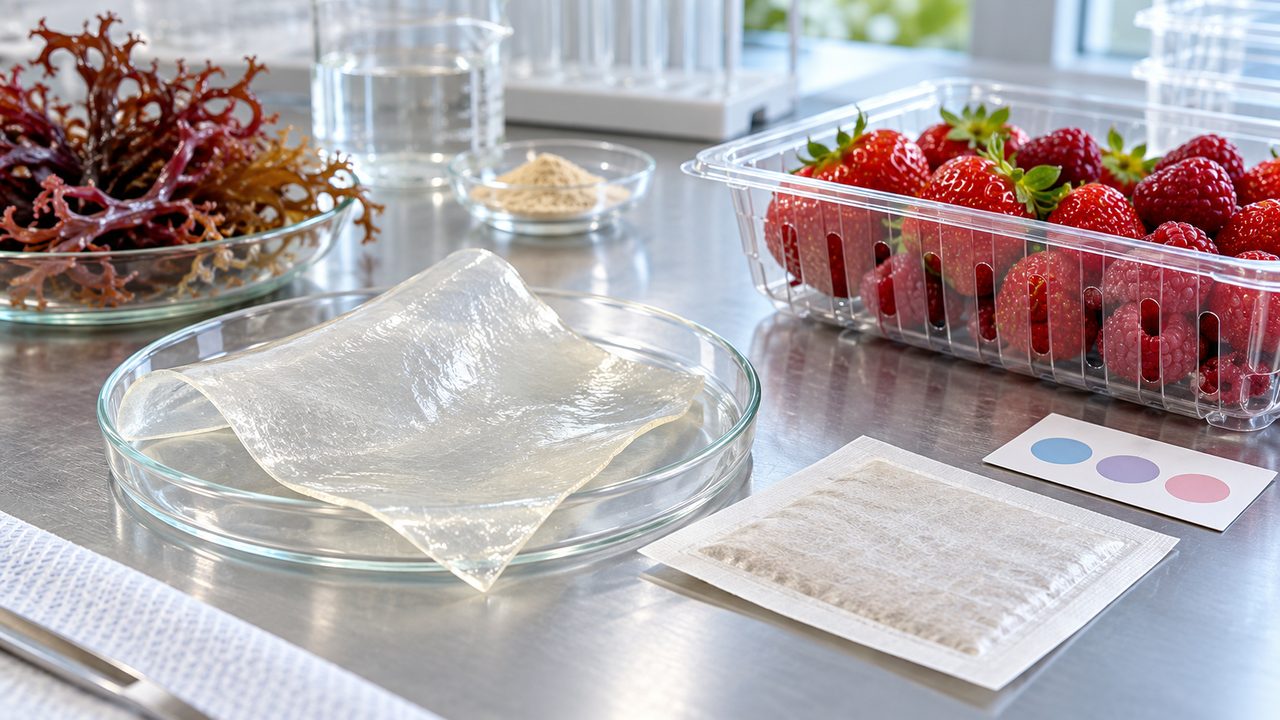
A materials study published on 18 October 2026 makes hydrogel films from carrageenan and gallic acid. The proposed use is a moisture-absorbing pad in active food packaging. Structure, surface, mechanics, thermal behaviour, swelling and moisture uptake were examined, but not yet with packaged food or in a market test.
Gallic acid increased moisture uptake in the stress test
At high relative humidity of 90% and a temperature of 50°C, the carrageenan-gallic acid film absorbed about 80% more moisture than pure carrageenan film, according to the abstract. Uptake-kinetics modelling also gave the blend a higher theoretical capacity.
These conditions are a deliberate laboratory stress test, not a typical refrigerator. The result shows that the formula can bind moisture. It does not show how fast a pad works in a real tray, how long it remains stable or whether it improves juice loss, odour, colour and texture for a particular food.
An absorber pad is more than an absorbent film
For practical packaging, material quantity, position, sealing and air exchange must suit the food. An undersized absorber achieves little; one fitted poorly could dry out, tear or permit unwanted contact. Production speed, storage and the disposal route matter too.
The paper calls carrageenan and gallic acid natural starting materials. Natural does not automatically mean compostable or safe for food contact. Barrier behaviour, migration, microbiological stability and end-of-life performance all need separate testing for the specific construction.
Active materials require their own safety assessment
In the EU, food-contact materials must be manufactured so that substances do not migrate at levels that endanger health or unacceptably change taste or composition. Regulation (EC) No 450/2009 adds specific requirements for active and intelligent materials.
The study is therefore a materials demonstration, not an authorisation. Its abstract reports neither migration tests with food simulants nor a toxicological assessment. A later industrial barrier layer or wrapper may also determine whether and how the hydrogel contacts food or the package headspace.
Is the film PFAS-free? That was not investigated
The approach uses no fluorine chemistry mentioned in the abstract. That does not support a verified “PFAS-free” statement: the work describes no targeted PFAS analysis, complete supply chain or finished packaging system. Such a claim would need robust evidence for raw materials, processing aids and the final product.
- Look for clear material and disposal instructions on absorber pads.
- Do not open damaged pads or mix their contents with food.
- Treat biobased, natural, compostable and PFAS-free as separate properties.
- For fresh food, do not let packaging claims replace the cold chain or use-by date.
Kochzauber's recipes by ingredient and recipes by meal offer practical ways to use leftovers. Packaging may support shelf life, but it replaces neither hygiene nor the correct storage temperature.
Conclusion: a strong laboratory signal with evidence still missing
In this study, carrageenan and gallic acid form a much more absorbent moisture scavenger than carrageenan alone. That makes the blend interesting for further packaging research. Real-food trials, migration and safety work, shelf-life studies, scaled manufacturing, disposal assessment and robust support for any environmental claims are still needed before use.
Sources
- Journal of Macromolecular Science, Part B: original study, online 18 October 2026
- European Commission: food-contact material requirements
- EUR-Lex: regulation on active and intelligent materials
- European Chemicals Agency: PFAS overview
Author: Kochzauber editorial team. Updated: 19 October 2026. This article reviews a materials prototype; safety, authorisation and PFAS-free status are not established.