Bio-based does not automatically mean compostable: new review explains bioplastics
A new review maps the promise and limits of plastics made and degraded by microbes. What packaging terms mean – and why they do not prove that a food pack is PFAS-free.
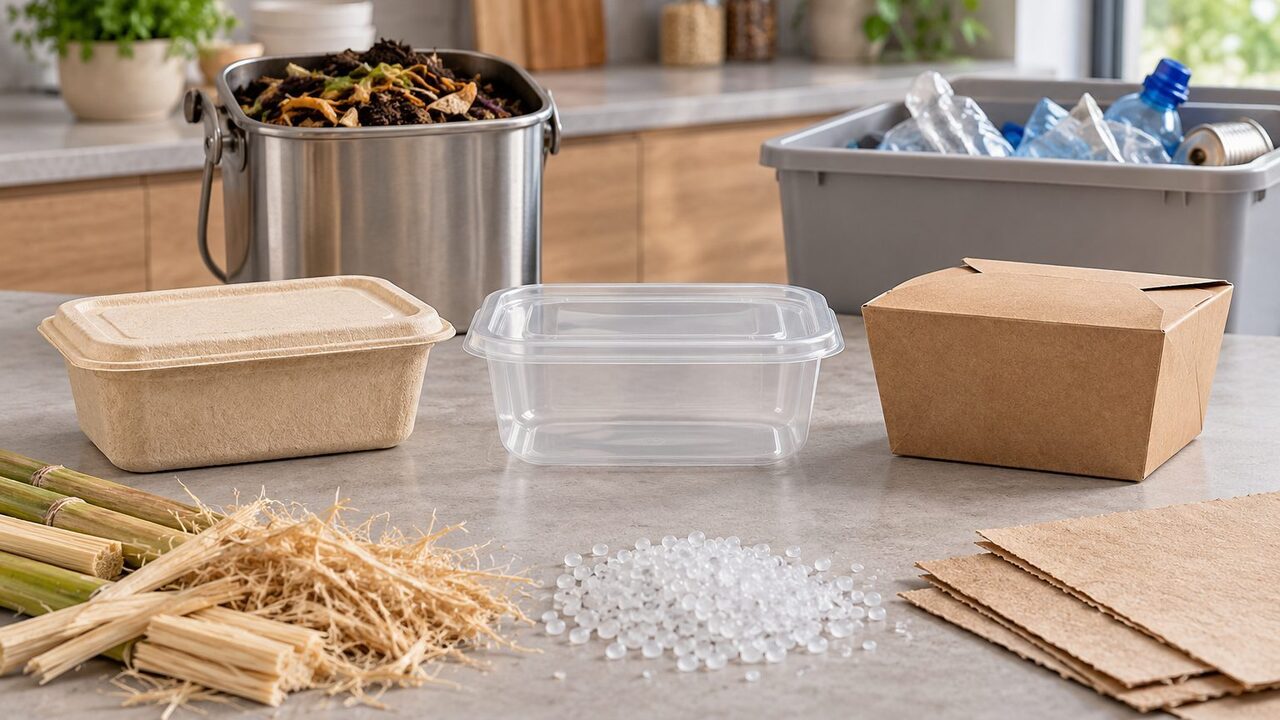
A review published on 1 October 2026 describes how microorganisms can make bio-based plastics and break them down under specific conditions. Its central lesson also cautions against simplified packaging claims: biological feedstock, biodegradability and compostability are separate properties. None of them alone proves that food packaging is PFAS-free or suitable for home composting.
What the new review examines
The international team follows the life cycle of important bio-based polymers. These include polyhydroxyalkanoates, bacterial nanocellulose and microbially produced building blocks for polylactic acid and polyethylene furanoate. It considers production as well as biological breakdown.
This is a review of existing research, not a market test of individual packages. The authors find widespread genetic capacity in microorganisms but identify low volumetric productivity, carbon inefficiency and difficult downstream processing as production barriers.
Three terms with three different meanings
- Bio-based describes origin: a plastic is made wholly or partly from biological resources.
- Biodegradable describes a possible end under defined conditions; the raw material may be biological or fossil-based.
- Compostable is a subset of biodegradable material and normally refers to specified treatment conditions.
The European Commission likewise warns that the umbrella term “bioplastics” can confuse. A bio-based plastic is not necessarily biodegradable, while a biodegradable plastic may contain fossil feedstock.
Why the disposal environment matters
Microbes do not break down a material equally everywhere. Polymer structure, crystallinity, temperature, moisture, oxygen and the available organisms shape the process. According to the review, efficient degradation is often limited to managed systems.
A “biodegradable” label is therefore not permission to leave packaging in nature or a garden. Without suitable collection and treatment, the intended process may not happen. Local waste rules and a specific, verifiable label are what matter.
What this means for food packaging
Packaging has to protect food and fit a functioning waste system. The EU Packaging and Packaging Waste Regulation has applied since 12 August 2026. It requires compostability for certain formats and, in principle, material-recycling design by 12 February 2028 for other biodegradable plastic packaging.
The more appealing material idea is not automatically the better real-world option. Barrier performance, food safety, material quantity, reuse, sortability and available infrastructure belong in the same assessment.
Biodegradable does not mean PFAS-free
The review analyses microbial polymer pathways and degradation conditions. It does not test finished food packages for PFAS, other coating chemicals or migration into food. “Bio-based” and “compostable” therefore cannot establish PFAS-free status.
Consumers and buyers seeking lower-hazard packaging should request a clear material and chemical statement or credible test evidence. Vague green language cannot replace food-contact compliance or a substance-specific claim.
A practical packaging check
- Avoid: is packaging needed for this food at all?
- Reuse: is there a hygienically suitable reusable option?
- Read the material claim: does it specifically say bio-based, industrially compostable or recyclable?
- Check disposal: does the local system accept this exact format?
- Separate chemical claims: only an explicit, supported statement can address PFAS or another substance group.
Food safety and manufacturer instructions come first when packaging is damaged, soiled or unsuitable. Improvised reuse is not appropriate for every single-use material.
Conclusion: a circular system needs more than a green label
Microorganisms may supply important building blocks for a circular plastics economy. The review shows that production and end-of-life must be designed together. Clear terms, local waste routes and substance-specific evidence are more useful than broad “bio” claims. Find low-packaging meal ideas in our recipes by ingredient and recipes by meal.
Sources and update
- Bruch et al., Nature Reviews Microbiology: review of microbial synthesis and degradation of bio-based plastics, published on 1 October 2026.
- European Commission: definitions and EU policy framework for bio-based, biodegradable and compostable plastics.
- European Union: Regulation (EU) 2025/40 on packaging and packaging waste.
Author: Kochzauber editorial team. Information updated on 2 October 2026. This article does not assess a specific package or confirm PFAS-free status. The cover is an editorial symbolic image.